

EMDR For Perfectionism and Chronic Shame in NYC: Effective Therapy for Women in Leadership
You are on top of your game and yet, there is something that feels “off.” The thing you don’t want to admit is that you are pretty sure you don’t belong in the spaces you’re in. It’s hard to believe that it’s your own hard work, and not dumb luck and sneaking in back doors, that brought you to the top of your field.
If you are a woman in a leadership role, my therapy practice is tailored to help you balance the perfectionism that drives you with your desire to feel grounded in your excellence. I offer therapy in NYC in an empathetic, highly attuned, anti-oppressive practice. My practice offers secure, HIPAA-compliant telehealth for high achieving New York-based women in leadership.
When you struggle with ADHD, the hidden effort hides your struggle
No matter how many accolades you receive, it’s the sinking feeling that you’re going to be found out that keeps you working late, perfecting each email and project before it goes out. The people around you don’t realize how much effort it takes to stay organized. Internally your brain is pinging between wondering if you left the hair straightener plugged in, whether your first meeting is at 8:30am or 9:00 and hoping you’ll get to see the kids for more than 5 minutes before their bedtime. All to try to rein your focus back to the task at hand.
You hide your struggle from your colleagues because it would prove that you shouldn’t be in your role.
When you’re used to seeing results, therapy shouldn’t be never-ending
I am here to help you untangle the “stuck” places. With my support, you will help you learn to focus inward to attend to your bodily experience and connect your somatic experience to your thoughts, beliefs, and actions. This is not a place to come vent; therapy is empathetic and goal-oriented. Together, we’ll explore strategies that feel meaningful and work for you. You know there’s something older that drives your perfectionism – a reason you’ve never felt “good enough.” Therapy can go deep or we can end when you have the coping skills you came in for. I’ll always be honest with you about your options so that you can choose what’s right for you.
The Result: You will leave therapy with more than just “coping skills.” You’re going to find yourself moving from rundown and pushing through to energized and honoring your limits. This is not about slacking. This is about reconciling the reality of your workplace and the reality of being a human being.

When you’ve been struggling quietly, it adds to the sense that something is wrong with you
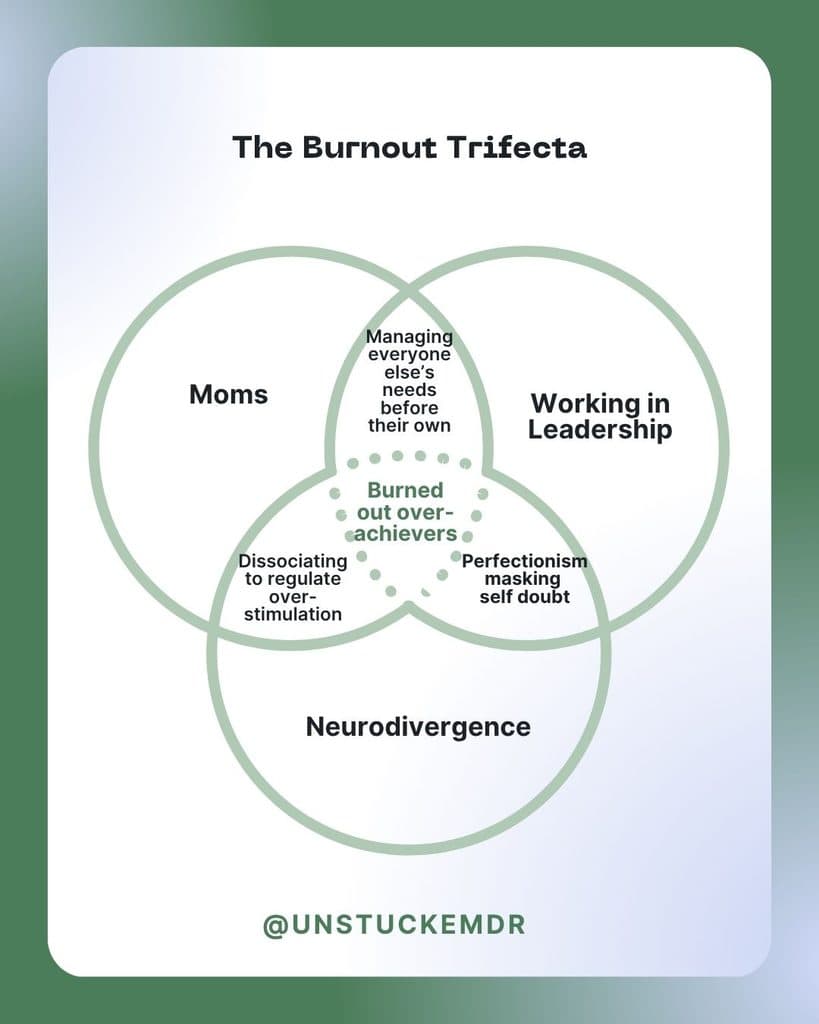
My therapy practice is neuroaffirming. Many of the professionals who come to me for therapy were diagnosed with ADHD or autism later in life (meaning, after childhood). You have found effective strategies for managing your symptoms on your own, but struggling quietly has added to the feeling that something is wrong with you. While it’s a strength to have managed so independently, it has also fed back into the anxiety of being found out and the need to hide.
I specialize in supporting neurodivergent high achieving women in NYC with the following:
If you secretly feel like a failure, it’s important to identify and work through the early experiences that fuel that narrative.
- EMDR for helping professionals in NYC: Using EMDR to process the shaming beliefs you hold about yourself.
- Chronic stress & burnout: If you feel like you spend your days reacting instead of responding the way you want to, somatic-focused therapy to support you.
- EMDR intensives: 90-minute or 3-hour EMDR sessions for the professional whose schedule is too unpredictable to commit to a recurring appointment. When you want deep healing today, but don’t know if you can make it back within the month, EMDR intensives might be the right fit for you.
Fees
When needed, I offer reduced rates for people working in entry-to-mid-level positions in non-profits and community health centers.
$250 for 75-minute initial session, $205 for follow-up sessions (55-minute sessions)
$308 per 90-minute session (EMDR and couples therapy sessions).
$1000 per 3-hour EMDR intensive (note: This books my time for the day and covers prep and aftercare)
I provide a “super bill” to simplify using your out-of-network benefits.
Frequently Asked Questions (FAQ) About Therapy for high-achieving women in New York, NY
Will therapy make me lose my edge at work?
No way! Therapy for burnout will help you identify your priorities, build tolerance for workplace annoyances, and feel more grounded in your decision making. Furthermore, working through the shame you carry will help you show up more fully and embrace your strengths.
Is virtual therapy effective?
Yes! Research shows, and it has been my experience, that therapy via telehealth is just as effective as in-person therapy. While I often miss offering therapy in-person, a fully virtual telehealth practice helps me keep my fees affordable for the people I work with. Additionally, the people I most enjoy working with (neurodivergent women, high-achieving professionals, healthcare professionals, and moms) appreciate the flexibility that telehealth therapy provides. Not commuting to an office means more time with their families and the ability to hop into a therapy session between work meetings, over a lunch break, or before starting work.
Please share your credentials
I am a Licensed Clinical Social Worker in Maine, New York, and Colorado. To maintain my clinical license in New York, I complete 35 hours of continuing education every three years.
My graduate work was completed at Columbia University, where I completed a program to earn my Master’s Degree in Social Work and Master’s Degree in Public Health.
To become an LCSW in New York, I completed 2000 hours of supervised clinical experience within 5 years of graduating and passed a national exam on clinical social work practice.
Additional credentials:
- EMDRIA-certified therapist and Approved EMDR Consultant. To retain this credential, I complete 12 hours of continuing education in EMDR practice within every 2 year period.
- Certified Perinatal Mental Health Practitioner (PMH-C). To retain this credential, I complete 12 hours of continuing education within every 2 year period.
What is a phone consultation?
You can learn a lot from reading someone’s website, but you can’t get a feel for your therapist without at least hearing their voice. This is your first opportunity to meet a therapist. You’ll want to hear that your therapist knows something about your unique experience and has a plan to help you. Your therapist should be able to speak to that. And, even if someone knows what they’re talking about, they still might not feel like the right fit for you and that’s OK.
My consultations are 15-minute phone calls. It’s free of charge and there’s no pressure to move forward.
Do you only offer EMDR therapy?
No. In addition to being an EMDRIA-certified therapist, I have advanced training in Cognitive Behavioral Therapy (CBT). My additional training in schema therapy, somatic therapy, dialectical behavioral therapy, and internal family systems therapy informs my therapy practice.
Because we never dive right into EMDR processing, I use somatic practices, CBT, and DBT skills to help you find stability through the initial phases of EMDR. Some people choose to move into EMDR work for deeper trauma healing and recovery, while others feel comfortable meeting less frequently or ending therapy once they have moved through the acute situation/s that brought them to me.
Why should I trust you? What experience do you have supporting high-achieving women?
Treating high achieving women in leadership has made up a substantial part of my therapy practice since 2020. At that time, healthcare professionals came into my practice to process the trauma of their jobs during the COVID-19 pandemic. They came to me feeling exhausted, disconnected, and numb. We’ve worked through burnout, grief, acute workplace traumatic events, and vicarious trauma to find relief, connection, and the ability to experience the joy at their weddings, births of their children, and other life events.
I have supported high-achieving professionals as a therapist since 2018 and as a clinical supervisor and manager since 2017. When your identity is wrapped up in your output at work, it’s easy to lose track of yourself and why you’re working so hard. If you secretly feel like you’re a failure, it’s important to identify and work through the early experiences that fuel that narrative.
Are there benefits to paying outside of insurance?
There are a couple of benefits to paying out of network. One is that it keeps therapy out of your medical record. While mental health care is now more accepted as an important part of self care, it is still stigmatized in certain fields and communities. People also have real concerns about how their diagnosis or mental health treatment might impact their professional growth. Being out of network offers discretion and privacy.
Additionally, paying out of network means that there aren’t restrictions on the work we do. We will talk about length of treatment, costs, and treatment planning from our very first phone consultation. Insurance plans sometimes restrict the number of therapy sessions they’ll reimburse or only reimburse for certain modalities for specific disorders. EMDR is a great example of this: Many insurance companies will only reimburse EMDR therapy if you have a PTSD diagnosis, despite trauma having pervasive effects that may not meet the diagnostic threshold for PTSD and EMDR being evidence based for anxiety, depression, and grief.
I offer a monthly “super bill” to support your reimbursement. This bill will include your information, a diagnosis, and the billing code and cost for your session.